In France, the number of recipients of the APA at home decreased by 0.7% in 2025 according to the DREES, a first after several years of continuous increase. This figure reflects a paradox: while the population is aging, human assistance is decreasing. The equipment installed in seniors’ homes is becoming a direct lever to compensate for the scarcity of professional support. Adapting one’s home is no longer a matter of optional comfort; it is a structural response to a measurable social assistance deficit.
Decline in home assistance: what it changes for senior equipment
The provisional 2025 data from the DREES establishes that 837,000 elderly people benefit from social assistance at home in mainland France and in the DROM (excluding Mayotte), representing a decrease of 0.8% year-on-year. This decline occurs for the first time since 2020.
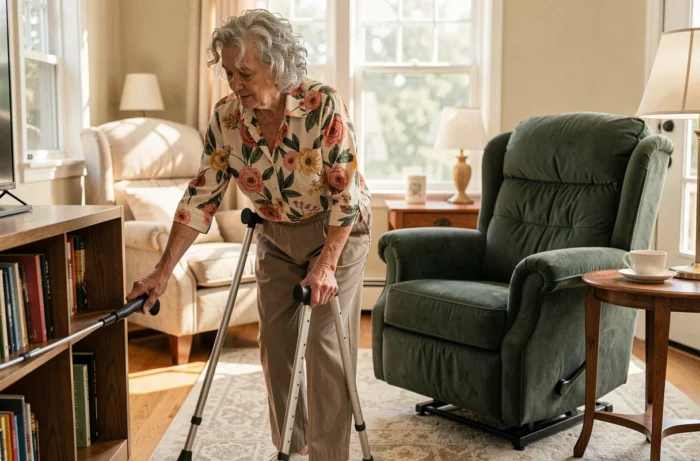
The direct consequence is rarely discussed: when hours of human assistance are reduced, equipment takes over. A senior who has a grab bar in their bathroom or a lift chair in the living room relies less on a caregiver for simple actions like getting up, showering, or moving between rooms.
To consult detailed sheets on these solutions, the site offers resources about Seniors des Infos that categorize equipment by use and by room in the home.
The PLFSS 2026 also includes housing adaptation as a standalone budgetary axis in the autonomy section. MaPrimeAdapt’, the national funding scheme for renovation work, sees its scope confirmed. The arbitration between human assistance and material equipment is therefore no longer theoretical: it is included in the budgetary programming.
Bathroom and toilets: safety equipment that reduces the risk of falls
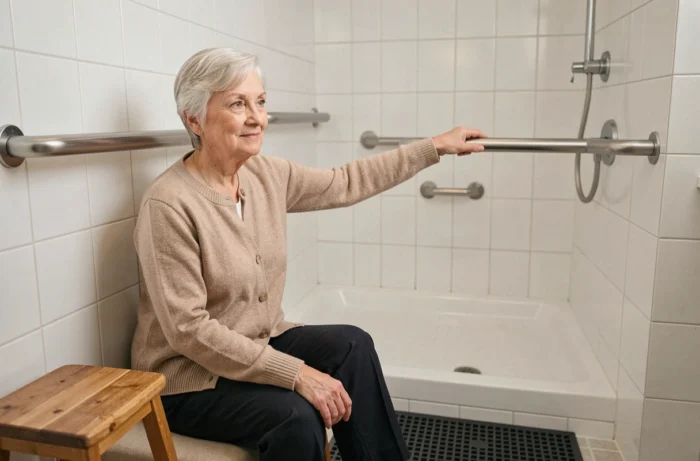
The bathroom accounts for the majority of domestic accidents among the elderly. Wet floors, the movements required to step into a bathtub, and the lack of support points create a high-risk environment.
The equipment that truly modifies this risk is not all spectacular. Some cost just a few dozen euros, while others require plumbing work. Their common point: they act on actions repeated several times a day.
- Wall-mounted grab bars fixed next to the toilet and in the shower, positioned at hip height to facilitate the sitting-to-standing transfer without twisting the torso
- Folding wall-mounted shower seat or non-slip stool, which eliminates prolonged standing on a wet floor
- Toilet riser with integrated armrests, useful when bending the knees becomes painful or limited
- Replacing the bathtub with a step-free walk-in shower, an intervention eligible for MaPrimeAdapt’ under certain income conditions
A detail often overlooked: the height at which grab bars are fixed. If too high, the bar forces the shoulder. If too low, it does not stabilize the pelvis. Installation by an occupational therapist or a trained professional avoids this type of error.
Lighting and flooring
A standard tiled floor becomes slippery as soon as it is wet. Non-slip classified tiles (barefoot slip resistance standard) change the game. Automatic lighting with motion detectors, installed between the bedroom and the bathroom, also secures nighttime movements without the senior having to search for a switch in the dark.
Living room and bedroom: lift chair, adjustable bed, and useful home automation
The living room and bedroom are the two rooms where seniors spend the most time. The equipment installed there must meet a specific goal: reduce the physical effort of postural transitions (sitting to standing, lying down to sitting).
The electric lift chair remains the most documented equipment. Its motorization tilts the seat forward to assist the lifting movement without straining the knees or lower back. However, not all models are equal. Chairs with a single motor do not separate the inclination of the backrest and footrest, which limits intermediate resting positions.
The height-adjustable bed (sometimes referred to as a medical bed) facilitates the transition to a sitting position thanks to the rising mattress. Some models include removable side rails. Feedback from the field varies on this point: the rails reassure some users but hinder others who perceive them as a hospital constraint.
Targeted home automation rather than a connected home
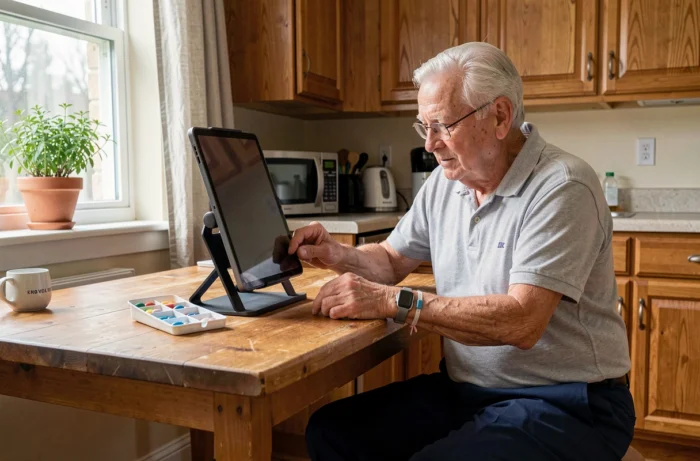
The idea of a house fully controlled by a tablet is appealing on paper. In practice, seniors adopt isolated and simple devices better: a connected smoke detector that alerts a relative, a programmable socket to automatically turn off a cooking appliance, a LED light path activated by a sensor between the bed and the toilet.
Teleassistance (medallion or bracelet with call button) remains the most used connected device. Its effectiveness depends on the response time of the platform and the senior’s ability to wear the device at all times, including in the shower.
Funding and access to equipment for home care
MaPrimeAdapt’ finances part of the housing adaptation work (step-free shower, access ramp, motorization of shutters). The scheme targets owner-occupiers and tenants under certain income and age conditions. Processing times for applications vary by department.
The APA at home can also cover the purchase of certain equipment when they are included in the assistance plan established by the medical-social team of the departmental council. The distinction is clear: MaPrimeAdapt’ finances the structure, the APA finances the use.
- Grab bars, shower seats, and toilet risers often fall within the APA assistance plan
- The lift chair may be partially covered if medically prescribed
- Bathtub replacement work falls under MaPrimeAdapt’
The decline in the number of APA recipients at home in 2025 raises an open question: do those who exit the scheme have sufficient equipment to compensate for the loss of human assistance? The available data do not yet allow for a conclusion on this point.