
On the ground, the first difficulty is never the equipment. It’s the perspective. You find yourself facing a scene, raise the camera, and the photo looks like what you’ve already seen everywhere. The click happens when you physically change your position, when you accept to crouch, step back, or move around the subject. Photography progresses through the angle you choose to adopt, not through the accumulation of settings.
Natural light constraint: working with what you have
When you arrive at a location without artificial lighting, the available light dictates everything. Rather than suffering from this constraint, you can turn it into a creative lever. Morning side lighting carves out volumes and reveals textures invisible in broad daylight.
The classic trap is to wait for the “golden hour” and ignore the rest of the day. The hours of harsh light, between noon and three o’clock, produce strong shadows that structure a street or architectural image. Using cast shadows as compositional elements transforms a moment that most photographers avoid into a graphic opportunity.
You can discover various approaches on soustouslesangles.fr, where photography is explored through concrete situations and underutilized shooting angles.
Opinions vary on this point, but many field photographers find that a uniform overcast sky simplifies exposure management for outdoor portraits by eliminating overly harsh contrasts on faces.
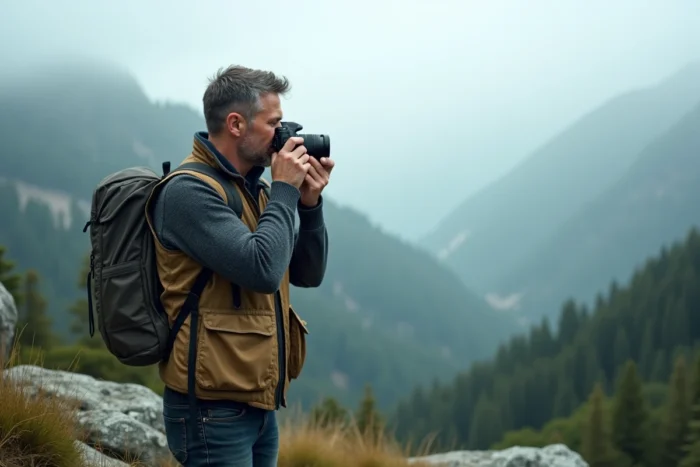
Field composition: three reflexes that change a photo
Composition is not limited to the rule of thirds. In the field, three operational reflexes produce sharper results than any mechanically applied theoretical principle.
- Change height before shooting: kneeling down or raising the camera overhead radically alters the relationship between the subject and the background. A market scene photographed at stall height tells a different story than a bird’s-eye view.
- Look for an active foreground: a sharp element in the foreground (foliage, fence, object) creates depth and anchors the viewer’s gaze before they explore the rest of the image.
- Simplify the scene by getting closer: when the background is cluttered, taking two steps forward and framing more tightly eliminates visual noise. The subject gains presence without any post-processing.
These reflexes work with a camera just as well as with a smartphone. The quality of the sensor matters, but the photographer’s placement matters more.
Photo editing and generative AI: what changes concretely in 2026
The integration of artificial intelligence tools into editing software has changed the daily workflow. Automated image sorting, removal of distracting elements, and sharpening enhancements speed up post-production.
The point of caution concerns transparency. Article 50 of the European AI regulation requires providers and users of AI systems generating or manipulating images to clearly indicate these contents as AI-generated or modified. This framework, fully applicable from August 2026, directly affects photographers who publish images edited by generative tools.
In practical terms, this means that a professional photographer distributing AI-edited portraits on their communication channels will need to document the production chain of their images. The making-of and justification of aesthetic choices become elements of compliance, not just storytelling.
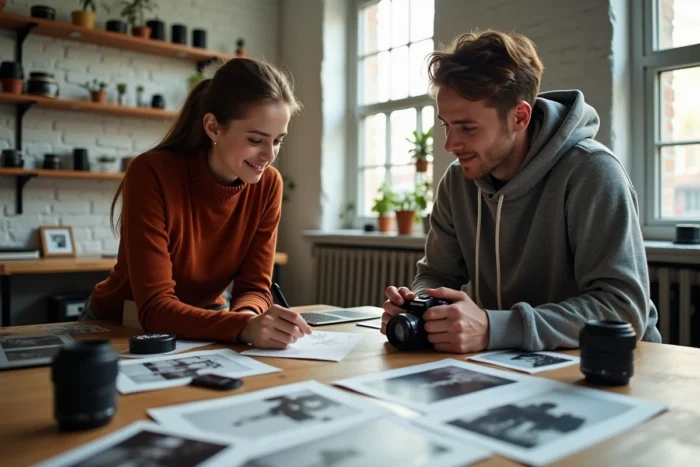
Distinguising classic editing from generation
A white balance adjustment or a crop does not fall under generative AI. Replacing an entire sky with an algorithm, altering a facial expression, or adding non-existent elements to the original scene falls within the scope of the regulation. The line is drawn between correction and fabrication.
For photographers exhibiting at festivals or selling prints, this distinction impacts the presentation of their work. Mentioning the use of AI in captions or technical sheets becomes a practice to integrate from the moment of shooting.
Smartphone photography: going beyond automatic mode
The majority of photos taken today are with a phone. Automatic mode produces decent images, but it smooths out creative choices. Switching to manual (or “pro”) mode on a smartphone allows control over exposure, focus, and white balance.
- Locking focus on an off-center subject forces the camera not to recalculate the focus point with each shot, stabilizing portrait series.
- Deliberately lowering the exposure by one or two stops creates silhouettes and contrasting atmospheres that are impossible to achieve in automatic mode.
- Disabling HDR in high-contrast scenes preserves deep blacks and avoids the “flattened” look typical of smartphone photos.
Manual mode transforms a capture tool into a creative instrument. The difference between a mundane phone photo and a striking image often lies in these three settings.
When the smartphone reaches its limits
In low light or for fast-moving subjects, a phone’s sensor shows its weaknesses. Digital noise rises quickly, and the algorithmic processing time introduces a delay that causes you to miss the moment. For sports or performance photography, a dedicated camera with a fast lens remains more reliable.
The choice of equipment depends on the situation, not an absolute hierarchy. A well-handled smartphone in daylight produces images that many poorly set DSLRs cannot match. What makes the photo is the decision made before the shutter is pressed: where to position oneself, what to include in the frame, what moment to capture.