The regulatory framework for guest houses in Brittany remains distinct from that of tourist rentals, and this distinction has further widened since the Le Meur law n° 2024-1039. Understanding these mechanisms allows for better accommodation choices, but also helps to grasp why certain Breton addresses maintain a more transparent economic model than traditional seasonal rentals.
Le Meur Law and Accommodation in Brittany: What Changes for Guest Houses and Gîtes
The Le Meur law, which came into effect at the end of 2024, targets short-term tourist rentals with a national registration requirement, reduced night limits, and enhanced energy requirements in tight zones. Guest houses are exempt from these new constraints. They remain governed by the Tourism Code: declaration at the town hall, a maximum of 5 rooms and 15 people, breakfast and linens included.
This regulatory asymmetry has a direct consequence on the Breton ground. Owners who operated a seasonal rental without a structure must now comply with a national register and face increased fines. Guest houses, on the other hand, continue to operate under a stable declarative regime. For travelers, this translates into a more sustainable offer: addresses that welcome guests under the guest house status are not subject to the same administrative uncertainties as Airbnb listings.
On the tax side, the Le Meur law has revised the micro-BIC deductions applicable to tourist rental income. Classified gîtes and guest houses retain a more favorable deduction than unclassified rentals. We observe that this tax lever encourages Breton owners to maintain or even obtain official classification, which raises the quality of hospitality.
Among the addresses that illustrate this structured hospitality model, chezagathe.com offers an approach rooted in the territory with breakfast and linens provided, in accordance with the legal framework for guest houses.
Classification and Labels for Gîtes in Brittany: Beyond the Stars
The official classification of a gîte or guest house is not just a marketing argument. Since the fiscal adjustments of 2025, it directly conditions the level of deduction that the owner benefits from. An unclassified gîte faces a less advantageous tax treatment, which can reflect on pricing or on investment in property maintenance.
In Brittany, several classification systems coexist. The Atout France stars apply to tourist rentals. Guest houses can be referenced by networks such as Gîtes de France, Clévacances, or independent labels. Each system evaluates different criteria:
- Atout France assesses the surface area, equipment, and accessibility according to a standardized national grid, but does not take into account the quality of human hospitality
- Guest house networks often include the table d’hôtes, the heritage character of the building, and the relationship with the owner in their criteria
- Some regional Breton labels value local anchoring: short supply chain sourcing, artisanal furniture, restoration of stone or granite buildings
We recommend checking the exact nature of the displayed label. A “3-star” gîte and a “3-ears” guest house do not measure the same things. The former guarantees a level of equipment, while the latter values a holistic experience.
Specificities of Breton Buildings: Granite, Longères, and Insulation Constraints
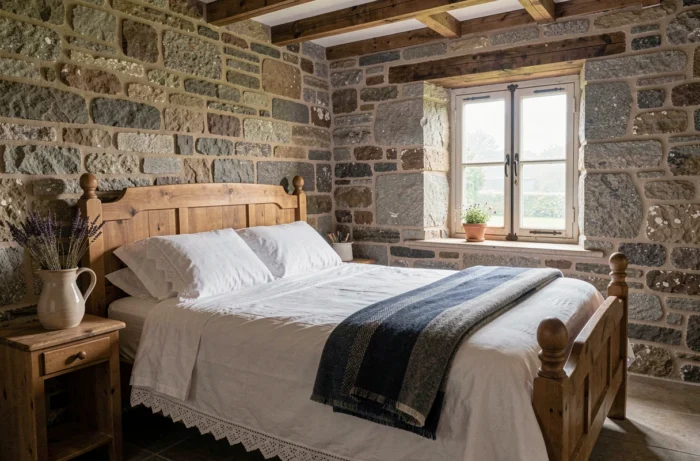
Breton guest houses often occupy old buildings: granite longères, manors, converted farmhouses. This architectural heritage is a major attraction, but it imposes technical constraints that travelers rarely perceive.
Breton granite is an excellent structural material but a poor thermal insulator. The 60 cm thick stone walls naturally regulate humidity but allow cold to pass in winter without added interior insulation. Owners who have invested in interior insulation (wood wool lining, lime-hemp plaster) offer significantly better thermal comfort.
Several indicators can help assess the quality of a renovation before booking:
- The mention of an EPC (energy performance diagnosis) in the listing, made more visible by new regulatory requirements
- The presence of supplementary heating in the rooms (wood stove, radiator), a sign that the owner has anticipated cool nights even in season
- Replaced windows with double glazing, often identifiable in photos (visible seals, thicker frames than the original fittings)
- A mechanical ventilation system, rare in old buildings but indicative of thorough renovation
Well-renovated longères, respecting the building and featuring effective insulation, represent the high-end of Breton gîtes. They stand out from superficial conversions where the charm of the stone hides insufficient thermal comfort.
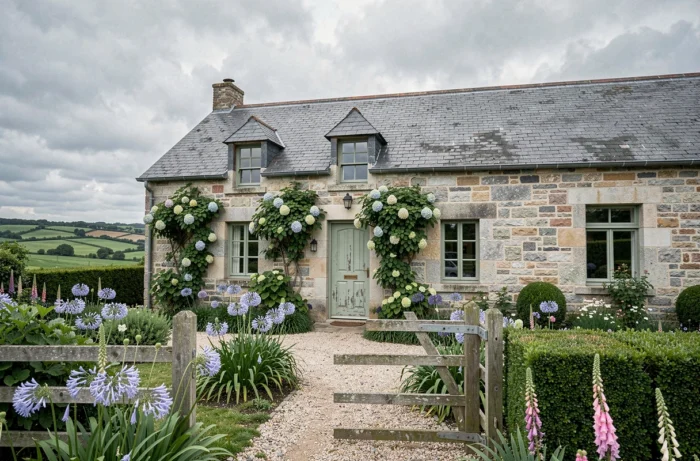
Table d’Hôtes and Short Supply Chains in Brittany: An Underestimated Choice Criterion
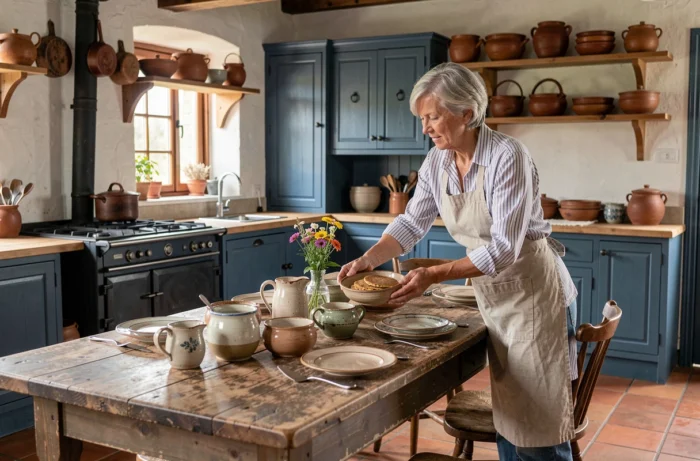
The table d’hôtes remains a distinctive marker of guest houses compared to gîtes and seasonal rentals. In Brittany, the proximity of producers (market gardeners, oyster farmers, artisanal creperies) gives the table d’hôtes a concrete gastronomic dimension.
Regulatory-wise, the table d’hôtes requires a unique meal composed of local products, served at the family table. The owner does not have the status of a restaurateur. This constraint ensures a meal rooted in the local terroir rather than a standardized menu.
For travelers, the table d’hôtes also allows access to local producers and artisans that no guide references. A host who has been established for several years in Trégor or the Pays Bigouden has a network of direct suppliers, from salted butter to flat oysters, enriching the stay well beyond the meal itself.
Brittany has a remarkable density of guest houses offering this service. Choosing an address with a table d’hôtes often means accessing the best of Breton terroir without searching for a restaurant. It is also the criterion that most clearly differentiates a guest house from a simple tourist rental offered on a booking platform.