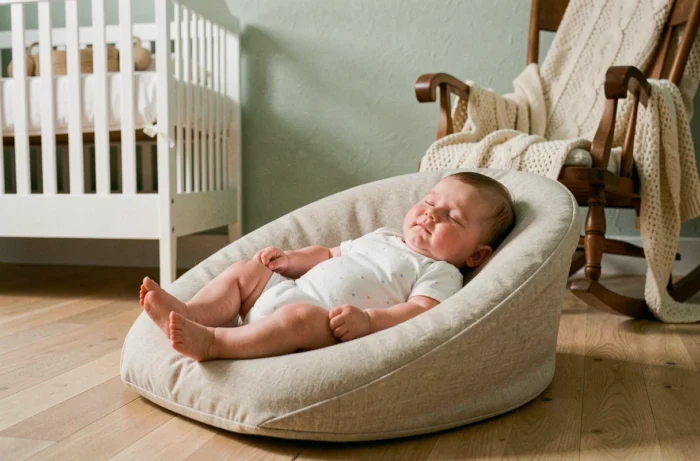
Between a floor-level bouncer and an elevated model on legs, the seat height affects much more than the aesthetics of the living room. It determines the overall stability, how the baby interacts with their environment, and the posture of the parent who leans in to adjust a harness or hand over a toy. Comparing a high bouncer and a low bouncer for babies requires measuring these differences against concrete criteria: safety, comfort, footprint, and duration of use.
High bouncer versus low bouncer: comparative table of selection criteria
| Criterion | Low bouncer (on the floor) | High bouncer (on legs or chassis) |
|---|---|---|
| Center of gravity | Very low, minimal tipping risk | Higher, stability dependent on the width of the base |
| Parent-baby interaction | The parent must bend down or sit on the floor | The baby is at table or countertop height |
| Contact with pets or older siblings | Accessible from the floor, direct proximity | Raised off the ground, more limited access for a young child |
| Folded footprint | Often compact and lightweight | Legs or chassis add bulk |
| Adaptability | Rarely convertible | Some models convert to high chairs |
| Compliance with safety standards | Applicable | Applicable, with reinforced stability requirements |
This table summarizes the structural differences. The following sections detail the discrepancies that weigh most in daily life.
To determine which high bouncer to choose for your baby, one must first understand how seat height modifies the child’s behavior and safety constraints.
Stability and safety of baby bouncers according to height
A low bouncer rests directly on the floor. Its center of gravity remains closest to the support surface, reducing the likelihood of tipping, even when the baby is fidgeting. This is a direct mechanical advantage that physics does not dispute.
A high bouncer compensates for its elevation with a widened base or spaced legs. The European safety standards govern both configurations and impose stability tests, but the elevated model requires more rigorous design to achieve the same level of resistance to tipping.
GPSR Regulation and traceability of bouncers
Since December 13, 2024, the European GPSR regulation imposes enhanced traceability on childcare products. Every bouncer sold in the European Union must display a clear manufacturer contact point and accessible technical documentation. This framework applies to both high bouncers and floor models.
Before purchasing, checking for the presence of this documentation on the packaging or product sheet ensures that the model complies with current requirements.
Risk of positional asphyxia
The height of the bouncer does not change a fundamental constraint: a baby who falls asleep in a bouncer must be transferred to a flat, firm surface. The semi-reclined position, common to both types, exposes the baby to the risk of positional asphyxia if sleep is prolonged. Safe sleep recommendations apply regardless of height.
Awakening bouncer or resting bouncer: a distinction more useful than height
Recent guides and rankings increasingly distinguish the awakening bouncer from the resting bouncer. The former prioritizes observation and interaction: slightly elevated position, play arch, visual proximity to the surroundings. The latter aims for relaxation, with a more pronounced recline and gentle rocking.
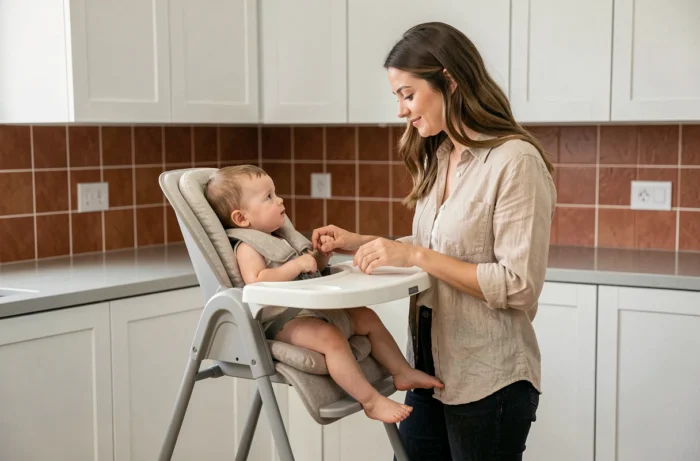
A high bouncer is more suited for the awakening function. Positioned at table height, it incorporates the baby into family life during meals or bottle preparation. In contrast, a low bouncer on the floor facilitates the transition to the play mat, where free motor skills can develop without constraint.
- For primarily awakening and table interaction use, the high bouncer offers ergonomic advantages for the parent and increased visual stimulation for the child.
- To alternate with floor phases and limit time in a semi-reclined position, the low bouncer makes transfers to the play mat easier without lifting the baby overhead.
- For families with a pet or a young sibling, the high bouncer reduces unsupervised contact at ground level.
The current trend emphasizes short bouncer sessions to preserve the baby’s motor skills. Regardless of the model, alternating between the bouncer and the floor remains the best strategy.
Footprint and adaptability of the baby bouncer
A low bouncer often folds flat and can be slid behind a piece of furniture or under a bed. Its lightweight makes it easy to move from room to room. This is a concrete advantage in homes where every square meter counts.
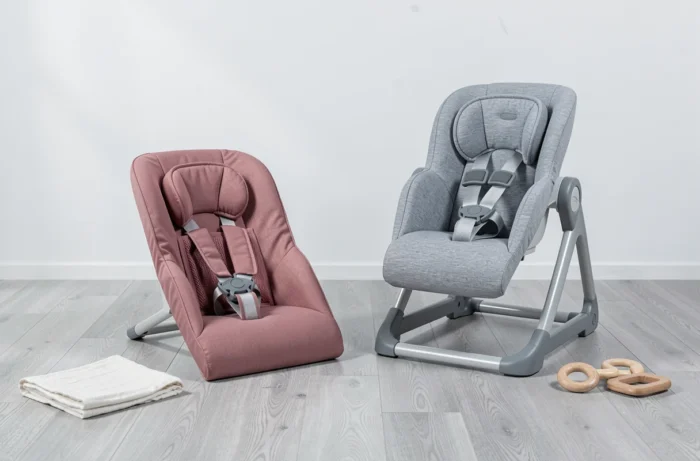
A high bouncer includes a chassis or legs that add bulk, even when folded. The trade-off, in some models, is an adaptability to a high chair: the bouncer converts to a dining seat as the child grows. This dual use can justify the extra bulk if the budget does not allow for two separate pieces of equipment.
Concrete criteria before purchase
- Measure the available space in the main room, with the bouncer unfolded, before choosing a high model whose base may exceed the footprint of an adult chair.
- Check if the cover is removable and machine washable: a young child can dirty a bouncer several times a week.
- Inspect the type of harness (3 or 5 points) and the sturdiness of the fasteners, especially on an elevated model where a fall would have more serious consequences.
- Look at the weight limit indicated by the manufacturer: it conditions the actual duration of use, often shorter than parents anticipate.
The choice between a high bouncer and a low bouncer rarely boils down to aesthetic preference. The configuration of the home, the presence of an older sibling or a pet, and the intended use type guide the decision more surely than design or brand. Comparing stability, actual footprint when unfolded, and compliance with current standards remains the most reliable method to identify the model suited to one’s situation.