
Chronos is the time and scheduling management software used by the CHU of Toulouse for its non-medical staff. For agents, accessing it daily requires going through a digital portal whose ergonomics have significantly evolved in recent years. The login process, which seems simple on paper, raises concrete questions: which portal to use, how to manage differentiated profiles, and what to do in the face of issues related to cookies or permissions.
RHstart Digihosp Portal: the single entry point at CHU Toulouse
Before the deployment of the unified portal, agents at the CHU of Toulouse had to juggle between several intranets and distinct applications to consult their schedules, request leave, or check their hour counters. This dispersion generated navigation errors and frequent calls to HR support.
The RHstart Digihosp portal now centralizes access to Chronos and other HR digital services. In practice, the agent connects to a single interface that combines time management, leave requests, and schedule tracking. This consolidation reduces the number of passwords to remember and the number of pages to navigate before reaching the desired functionality.
For agents looking to access Chronos CHU Toulouse, the RHstart portal is the most direct route. The homepage requires specifying the type of staff concerned right from the first step, which then directs to the appropriate menus and rights.

Chronos CHU Toulouse Login: Path by Agent Profile
A point often underestimated in user guides: the CHU of Toulouse applies a strict distinction between medical and non-medical staff in the login paths. This is not just an administrative nuance. The displayed menus, granted permissions, and even the online help sections differ based on the selected profile at the entry.
Non-medical staff: the standard Chronos path
The non-medical agent accesses Chronos via RHstart by selecting their profile right from the homepage. They then find their time counters, weekly schedule, and ongoing absence requests. The rights are calibrated to allow consultation and entry, without access to supervisory or validation functions.
Supervisors and HR Managers
Service managers have expanded access. They validate leave requests, adjust schedules, and consult the dashboards of their unit. This level of authorization requires specific activation by the human resources department, which assigns rights based on the organizational chart.
If an agent finds they do not have access to the expected functionalities, the most common cause remains a profile incorrectly linked in the HR directory. The correction must go through the IT department or the nearby HR manager, not through any manipulation in Chronos itself.
Chronos Connection Issues: GDPR Cookies and Browser
Field feedback varies on this point, but a significant number of agents encounter connection difficulties not related to their credentials, but to their browser configuration. The RHstart Digihosp portal applies a strict GDPR compliance policy on cookies. Specifically, a banner asks the user to set their preferences before any connection.
If this banner is blocked by a restrictive browser or by an ad-blocking extension, the login page may remain inaccessible or loop indefinitely. Technical cookies, which cannot be disabled, are necessary for the authentication process.
- Check that the browser allows session cookies for the RHstart portal domain
- Temporarily disable blocking extensions (uBlock, AdBlock) on the login page
- Preferably use an up-to-date browser (older versions of Internet Explorer regularly cause issues in hospital environments)
- Clear the browser’s cache and cookies if the page shows an error after several attempts
These actions may seem basic, but in a hospital context where shared computer stations often retain inherited configurations, they resolve a significant portion of support tickets.
Chronos and Quality of Life at Work: What Digital Time Management Changes
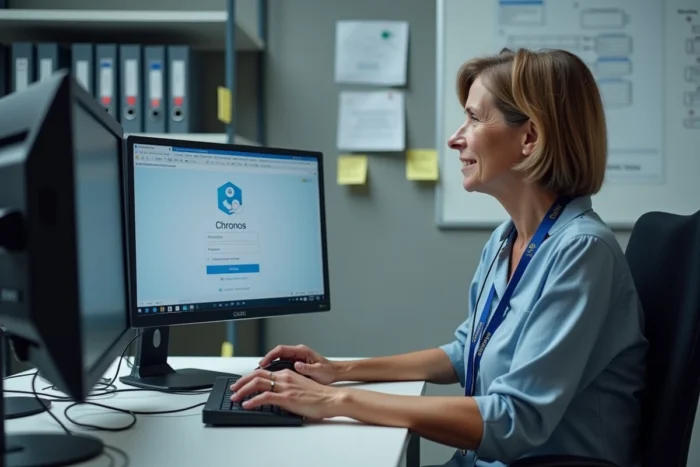
The deployment of Chronos at the CHU of Toulouse is part of a broader approach to quality of life at work. The stated goal is not limited to automating clocking in. It aims to give agents direct visibility over their counters, leave rights, and the status of their requests, without going through an intermediary.
This transparency has a concrete effect on the daily lives of care teams. An agent who checks their recovery balance in real-time makes their personal planning decisions more calmly. Managers, on their part, have a consolidated dashboard that facilitates the distribution of staff within care units.
The available data do not allow for conclusions about the quantified impact of Chronos in terms of reducing absenteeism or improving the social climate at the CHU of Toulouse. However, the logic of the unified portal, by eliminating paper processes and back-and-forth between departments, lightens the administrative burden for both agents and HR managers.
The transition to Chronos via RHstart Digihosp represents a change in habits for agents at the CHU of Toulouse. The login itself does not pose any major technical difficulties once the correct portal is identified and the browser is properly configured.
The real point of vigilance remains the linkage to the correct profile in the HR directory, a prerequisite for any functional access. For agents facing persistent blocking, the most effective reflex remains to directly contact the HR manager of their unit.