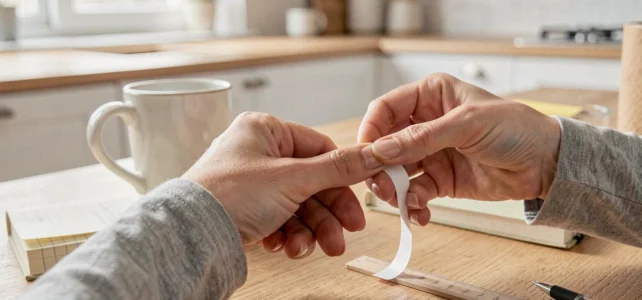
The ring size in France corresponds to the inner circumference of the ring, expressed in millimeters. A difference of just one millimeter is enough to make a ring uncomfortable or unstable on the finger. Here we detail the most reliable methods to obtain this measurement at home, avoiding common mistakes that distort the result.
Calibration error on printed ring sizer: the most frequent technical trap
The PDF ring sizer remains the most common tool for measuring ring size at home. Its main flaw is rarely reported: a zoom error of 1 to 2% during printing shifts the size by about one full size. Specifically, if your printer applies a slight automatic resizing (the “fit to page” option checked by default on most drivers), the circles on the ring sizer are all slightly reduced or enlarged.
The reliable check consists of placing a credit card on the printed calibration mark. The ISO/IEC 7810 standard sets the dimensions of a standard card at 85.60 mm in width. If the mark does not match to the millimeter, the document is unusable.
We recommend always printing by selecting “actual size” or “100%” in the print settings, then measuring the calibration mark with a ruler before using the ring sizer. Knowing how to measure ring size in mm first requires validating the measuring tool itself.
Measurement with string or paper strip: rigorous protocol in mm
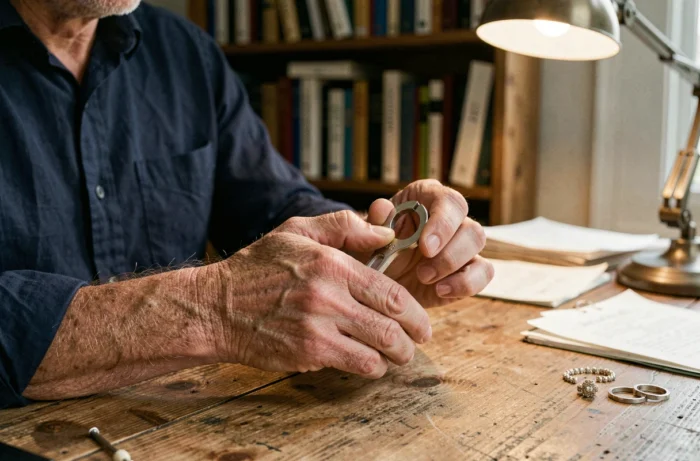
This method requires only a non-stretchable string (or a 5 mm wide paper strip), a fine pen, and a ruler graduated in millimeters. The principle is simple: wrap the material around the base of the finger, mark the overlapping point, and then measure the length obtained flat.
Protocol to limit measurement biases
- Wrap the string over the joint (proximal phalanx), not just around the base of the finger. A ring must pass over this joint to be worn, and its diameter is often larger than that of the base.
- Pull tight enough so that the string is in contact with the skin all around, without compressing the flesh. The string should neither slip freely nor leave a mark on the finger.
- Repeat the measurement three times and keep the median value. A difference of more than 1 mm between two measurements indicates a problem with tension or positioning.
- Measure the length obtained with a rigid ruler (not a flexible tape measure laid flat, which can bend). The result in millimeters directly corresponds to your finger circumference, thus your French ring size.
If in doubt between two sizes, we recommend the larger size. A slightly loose ring is more comfortable than a tight one, especially over time.
Screen measurement applications: reliability and limits in 2025
Recently, web tools and mobile applications have offered to place an existing ring directly on the smartphone screen to measure its inner diameter. Calibration is done with a credit card placed on the screen, allowing the software to calculate the pixel/millimeter correspondence of your specific device.
The advantage over the printed ring sizer is direct: no risk of scaling errors related to the printer. The reading of the inner diameter is done in real-time, in millimeters.
The main limitation concerns thick or curved screen protectors, which slightly alter the contact surface and can distort the positioning of the ring. On a bare and flat screen, the accuracy is comparable to that of a well-calibrated physical ring sizer.
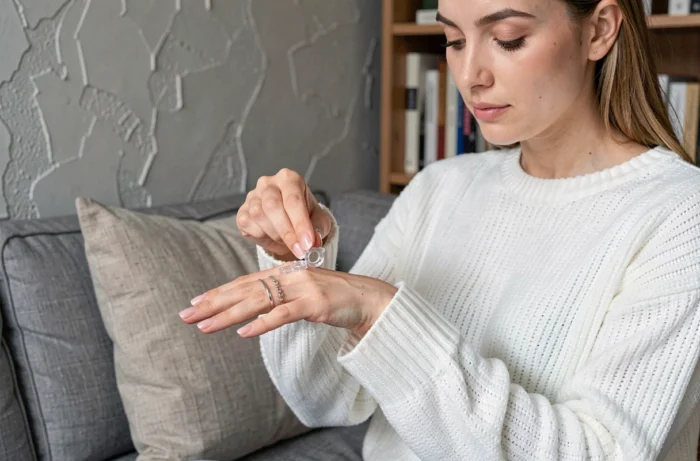
Conversion of inner diameter and circumference: correspondence table
The most common confusion concerns the difference between inner diameter and circumference. In French jewelry, size corresponds to circumference in mm, not diameter. The conversion from one to the other uses the formula C = π × d (approximately d × 3.14).
| Inner diameter (mm) | Circumference / FR Size (mm) |
|---|---|
| 15.3 | 48 |
| 15.6 | 49 |
| 15.9 | 50 |
| 16.2 | 51 |
| 16.6 | 52 |
| 16.9 | 53 |
| 17.2 | 54 |
| 17.5 | 55 |
| 17.8 | 56 |
This table covers the most common sizes. If you measure an inner diameter with a ruler or via an application, multiply by 3.14 to obtain your French size.
Time of day and temperature: often underestimated variables
The diameter of fingers varies according to body temperature and time of day. At the end of the day, after physical activity or in hot weather, fingers swell significantly. Conversely, a cool morning produces narrower measurements.
We recommend measuring in the late afternoon, at room temperature. This is the window where the finger is in its most representative state for daily wear. Measuring just after a hot shower or after prolonged exposure outdoors in cold weather distorts the result.
For a wide ring (beyond 8 mm in width), allow for an additional half size. The larger the contact surface between the ring and the skin, the greater the sensation of tightness at the same size.
The accuracy of a home measurement depends less on the chosen tool than on the rigor of the protocol. String, ring sizer, or application all yield usable results, provided the calibration is checked, the positioning over the joint is respected, and measuring at the right time of day. A residual difference of half a millimeter remains acceptable for an online order.