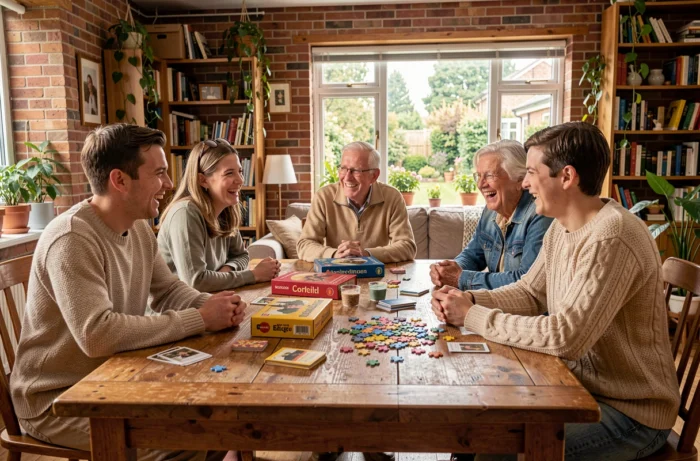
Comparing types of family leisure activities involves measuring three variables: preparation time, budget, and the level of interaction among participants. A creative workshop at home does not require the same resources as a trip to an amusement park, and the perceived satisfaction gap depends less on price than on the suitability of the activity for the ages of the children present.
Comparison Table of Family Leisure Formats
Before making a choice, it is useful to lay the data side by side. The table below distinguishes four main categories of activities based on their practical characteristics.
| Format | Preparation | Indicative Budget | Ideal Age Range | Family Interaction |
|---|---|---|---|---|
| Board games / home escape game | Low to moderate | Free to low | 6-77 years | Very high |
| Creative workshops (cooking, crafting, DIY) | Moderate | Low | 3-14 years | High |
| Nature outings (hiking, treasure hunts, biking) | Low | Free to low | 4-16 years | Moderate to high |
| Amusement park / immersive visit | Low (reservation) | Moderate to high | All ages | Variable |
The conclusion that emerges: the least expensive activities often generate the strongest bonds. Formats where each member actively participates (solving puzzles, cooking together) outweigh passive formats, regardless of the budget involved.
To explore various formats that cover several of these categories, discovering leisure activities with Joker Amusement allows you to visualize the range of available options, from skill games to interactive courses.
Hybrid Family Activities: Why the Immersive Format is Growing

Classic idea lists (coloring, indoor camping, home quizzes) saturate search results. What they do not show is the rise of hybrid formats that combine play, culture, and immersion. Supervised culinary workshops, urban treasure hunts, immersive visits to museums: these short, interactive, and multigenerational activities meet a demand that simple home entertainment does not cover.
The mechanism is simple. An eight-year-old and a fourteen-year-old do not get bored at the same pace. Hybrid formats address this issue by layering multiple levels of engagement: a physical course for the younger ones, puzzles or cultural content for the older ones.
What Distinguishes an Immersive Outing from a Traditional Outing
In a traditional museum visit, interaction is limited to observing and reading labels. In an immersive course, each participant manipulates, searches, and decides. The active engagement of each age group transforms the outing into a shared memory, rather than a chore for half the group.
“Reset days” (short days dedicated to a single interactive activity, without an overloaded schedule) are emerging in recent family practices. The principle: it is better to have one well-calibrated activity over two hours than three back-to-back activities that exhaust everyone.
Outdoor Games and Nature: The Most Favorable Effort-Enjoyment Ratio
Nature outings remain the format where the differential between investment (time, money, logistics) and return in terms of shared moments is most pronounced. A hike with an improvised treasure hunt costs nothing and occupies an entire afternoon.
Here are a few formats that work particularly well depending on age:
- Treasure hunt in the forest or city with photographic clues: suitable from age four, older children can design the course themselves, which doubles the engagement time.
- Timed nature challenges (building a shelter, plant identification): they introduce a competitive dimension without equipment, and adults participate on equal footing with children.
- Biking outings with thematic stops (a drawing stop, a snack stop, an observation stop): breaking up the route keeps younger ones’ attention on journeys that would otherwise be too long.
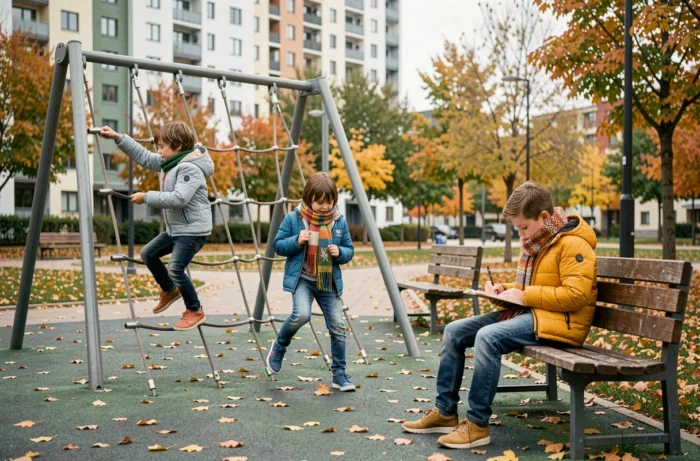
However, outdoor activities pose a constraint that idea lists rarely mention: the weather cannot be negotiated. Planning an indoor alternative (creative workshop, board game) avoids the frustration of a canceled program without a backup plan.
Accessibility of Leisure Venues: A Technical Criterion Often Ignored
When comparing amusement parks or playrooms, the entry price and attractions capture all the attention. The physical accessibility of venues, however, takes a back seat, even though it conditions the experience for families with strollers, grandparents, or children with disabilities.
Recent developments have occurred in the regulations applicable to public reception establishments (ERP). Controls on category 5 ERPs have been strengthened in 2025-2026, which directly affects playrooms, small indoor parks, and many family leisure structures. Operators of these venues must now meet more specific accessibility and safety requirements.
The Status of Defibrillators in Leisure Venues
The decree of December 5, 2025, clarified the obligations related to automated external defibrillators (AED) for certain public reception venues. ERPs in categories 1 to 4 remain subject to the obligation, while for category 5, the obligation is not general and depends on more specific criteria.
In practical terms, before booking an activity in a small amusement park or playroom, checking for the presence of an AED and the display of safety instructions provides a reliable indicator of the operator’s seriousness.
This type of verification does not appear in any “30 family activity ideas” list, but it conditions the peace of mind of an outing, especially with young children or elderly people.
Ultimately, the choice of a family leisure activity rests on a simple trade-off: the time spent together takes precedence over the budget, and active interaction among participants creates more lasting memories than passive entertainment. Short, immersive formats suitable for multiple ages simultaneously check both boxes with minimal logistical friction.