Choosing suitable garden equipment is based on measurable criteria: available space, material, frequency of use, and weather resistance. A survey published in 2026 shows that in 2025, 85% of French people with an outdoor space gardened, but only 68% purchased at least one gardening product, down from 76% the previous year.
Purchases are becoming rarer, and each piece of equipment must justify its place. This article compares materials, types of equipment, and technical criteria that determine the actual lifespan of outdoor arrangements.
Garden Equipment Materials: Comparative Durability
The choice of material determines both the initial budget, annual maintenance, and longevity. Three families dominate the market for outdoor furniture and structures: wood, metal (steel or aluminum), and woven resin. Their performance varies according to climate and exposure.
| Material | UV Resistance | Maintenance | Weight | Estimated Longevity |
|---|---|---|---|---|
| Wood (teak, acacia) | Average (graying) | Annual oil or saturator | Heavy | High if maintained |
| Aluminum | Excellent | Water cleaning | Light | Very high |
| Woven resin | Good (depending on quality) | Soapy water cleaning | Medium | Medium to high |
| Treated steel | Good (if powder-coated) | Rust control, touch-up | Heavy | High |
Wood remains the most sought-after material for its natural appearance, but it grays without treatment. Aluminum, on the other hand, requires almost no maintenance and withstands both sea spray and UV rays.
Woven resin offers a good aesthetic compromise, provided the quality of the weaving is checked: low-quality fibers break after two or three seasons of direct exposure.
To explore garden equipment with Clic Garden, simply filter by material and surface to target products suitable for your configuration.
Garden Equipment by Surface: Balcony, Terrace, or Large Garden
A balcony of a few square meters and a garden of several dozen square meters require different equipment. Adapting the volume and number of pieces to the actual surface avoids clutter and unnecessary purchases.
- On a balcony, prioritize foldable or stackable furniture and hanging accessories (vertical planters, wall lighting). Every centimeter counts: a 60 cm diameter side table is enough for two people.
- On a terrace, define distinct usage areas (dining, relaxation, planting) by playing with floor coverings or levels. A modular garden lounge allows reconfiguration of the space according to the number of guests.
- In a large garden, fixed furniture (stone benches, pergola, fire pit) structures the landscape. Automated irrigation systems and outdoor storage then make perfect sense.
Multifunctional furniture that transitions from outside to inside is gaining ground. Technical poufs, modular sofas, and UV-resistant textiles find their place on the terrace in summer, then in the veranda or living room off-season. This versatility reduces the number of pieces to buy.
Irrigation and Connected Equipment: Changing Daily Management
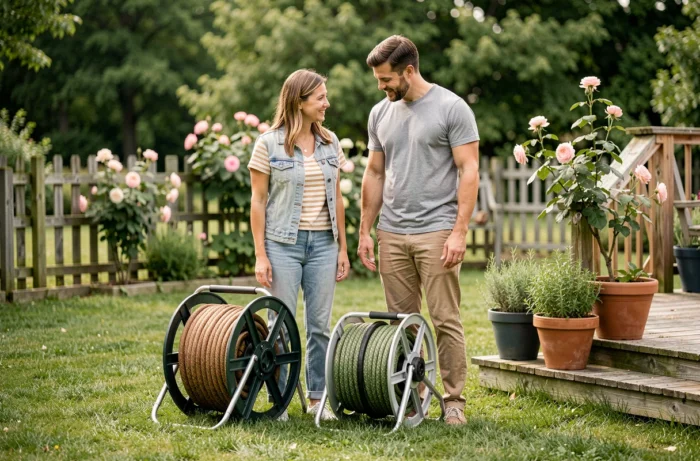
Irrigation is one of the most time-consuming tasks in garden maintenance. Manual systems (hose, watering can) are suitable for small areas or balconies. For a planted terrace or landscaped garden, a programmable automated irrigation system reduces water consumption and time spent.
Recent trends indicate a rise in so-called “smart” gardens: remote control of outdoor lighting, soil moisture sensors, connected outlets integrated into the layout. These devices allow you to control irrigation and lighting from a smartphone, simplifying management during extended absences.
However, these connected solutions are not justified everywhere. On a balcony with three planters, a mechanical timer costing less than twenty euros does the same job as a connected sensor. The technological investment must correspond to the actual complexity of the garden.
Neglected Selection Criteria: Warranty, Standards, and Winter Storage
Most comparisons stop at material and price. However, three additional criteria determine long-term satisfaction.
The manufacturer’s warranty varies from two to ten years depending on brands and materials. A five-year or longer warranty on aluminum furniture generally indicates solid construction. A short warranty on so-called “high-end” furniture is a warning sign.
Regulations also govern certain equipment. For fire pits and barbecues, rules differ by department and co-ownership. In Île-de-France, prefectural orders limit or prohibit outdoor fires depending on the municipality and the period. Checking local rules before purchasing combustion equipment avoids fines and unnecessary purchases.
Winter storage remains the blind spot of many purchases. A woven resin garden lounge left outside without a cover loses several years of life. Planning for a covered storage space (garden shed, garage, thick cover) is an integral part of the equipment budget.
- Check the duration and conditions of the warranty before purchase, especially exclusions related to UV or humidity.
- Consult local regulations for barbecues, fire pits, and fixed installations (pergola, shelter).
- Measure the available storage space for wintering before choosing the volume of the furniture.
The trend towards more targeted and reasoned purchases observed since 2025 reflects a maturity in the market. Buyers prefer fewer, better-chosen pieces that are compatible with their space and storage capacity. Well-selected garden equipment based on these technical criteria lasts longer, costs less in replacements, and truly transforms the daily use of outdoor space.