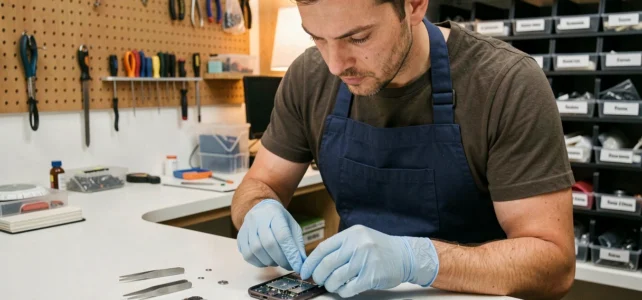
A cracked OLED screen on a Galaxy S24 is not treated the same as an LCD panel on a Redmi Note. The choice of repair technician, the quality of spare parts, and the regulatory framework governing the intervention determine the actual lifespan of the device after being serviced. Since July 31, 2026, the European directive 2024/1799 on the right to repair has reshuffled the cards between manufacturer customer service, certified networks, and independent technicians.
Grades of spare parts: what distinguishes a sustainable repair from a temporary fix
The replacement part determines the final result as much as the technical gesture. In the French market, smartphone screens circulate under three main grades: OEM (original manufacturer part or certified equivalent), aftermarket premium, and aftermarket standard. The difference is not limited to price.
An aftermarket standard screen on an iPhone 15 reproduces the mechanical dimensions, but the color calibration, maximum brightness, and edge touch sensitivity fall short. A qualified technician detects this at the first power-up. The aftermarket premium is closer to factory specifications, with a brightness level about 30% higher than that of the standard according to workshop feedback.
We recommend always asking about the grade before approving a quote. A transparent workshop displays the origin and category of each component, including the battery. To access the Mobile Junky webpage, the detailed sheets specify the type of part used for each intervention, allowing for comparison before visiting.
On the battery side, the nominal capacity of an aftermarket part can significantly deviate from the manufacturer’s value. Over a full charge cycle, this results in reduced battery life from the first weeks. A certified battery retains its capacity much longer than a generic clone.

European directive on the right to repair: what workshops must implement
The directive 2024/1799, fully applicable since July 31, 2026, requires smartphone manufacturers to offer repair as a priority over replacement during the two years of legal warranty. The text also covers the out-of-warranty period: manufacturers must provide spare parts and technical documentation at reasonable prices for any device listed as technically repairable.
For independent repairers, this directive changes the game on two concrete points. First point: access to original parts, historically locked by some manufacturers, becomes an obligation. Second point: each repaired device benefits from a warranty extension of at least 12 months after the intervention.
Tension between French law and European law on extended warranty
The French Consumer Code provides for a 6-month extension of the legal warranty of conformity after repair (Article L217-13). The European directive imposes a minimum of 12 months. This divergence creates a gray area that workshops manage on a case-by-case basis.
In practice, a QualiRépar certified repairer already applies warranty conditions aligned with European requirements. An unlabelled workshop may limit itself to the 6 months of French law until the transposition is finalized. We observe that informed customers now demand the 12 months, which pushes professionals to align.
Software diagnosis before hardware intervention: a step that serious workshops do not skip
A smartphone that restarts in a loop or whose touchscreen is unresponsive does not necessarily need a component replacement. Software failures represent a significant portion of devices received in workshops. A complete diagnosis, using tools like 3uTools for the Apple ecosystem or Phone Doctor Plus for Android, allows distinguishing a hardware issue from a software conflict.
- Checking the NAND status (flash memory): failing sectors cause freezes similar to a screen failure, unrelated to the panel
- Testing sensors (gyroscope, accelerometer, proximity): a faulty proximity sensor cuts off the screen during calls, often mistaken for a display issue
- Checking the charging and power circuit: a weakened micro-solder on the charging connector mimics a battery defect
A good diagnosis avoids unnecessary part replacement, thus preventing an inflated bill. Technicians who take the time for this step demonstrate a professional approach, not a reflex of systematic substitution.
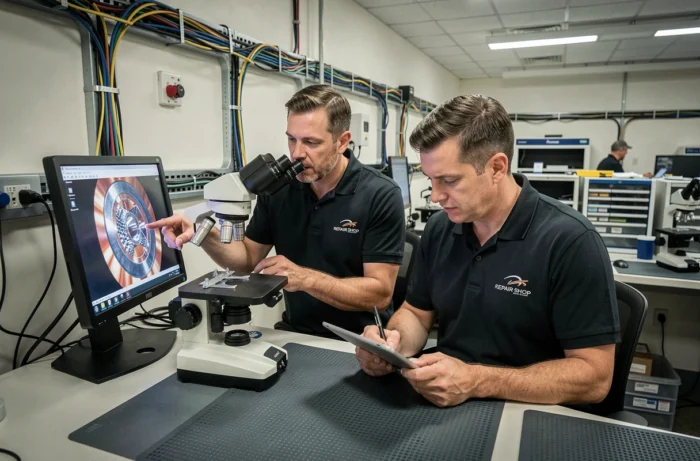
Smartphone repair and the QualiRépar label: the bonus that changes the economic calculation
The QualiRépar label, supported by the eco-organization ecosystem, provides access to a repair bonus funded by eco-contributions. For a smartphone, this bonus amounts to 25 euros, deducted directly from the bill at a certified repairer.
This amount may seem modest. On a screen replacement where the price varies by model, it represents a significant reduction, especially when combined with the extended warranty. The eligibility conditions remain strict:
- The device must be a smartphone or tablet listed among the covered products
- The repairer must hold an active QualiRépar label at the time of the intervention
- The failure must concern a functional defect (no aesthetic damage without impact on usage)
- The bonus applies only once per device and per type of failure
The list of certified repairers evolves regularly. Checking the label status before dropping off a device remains a basic precaution.
Post-repair optimization: calibration and checks to demand
A screen repair does not stop at installing the new panel. True Tone calibration on iPhones, for example, requires data transfer from the old screen via a dedicated programmer. Without this step, the automatic color temperature adjustment disappears.
On Android, replacing a battery must be accompanied by a recalibration of the charge controller so that the displayed percentage reflects the actual capacity. A workshop that returns the device without this recalibration leaves a discrepancy that amplifies over time.
Demand a detailed intervention report mentioning the tests performed, the exact reference of the part installed, and the applied warranty duration. This document serves as proof in case of disputes, particularly in the current context where post-repair warranty rules evolve between French law and European requirements.