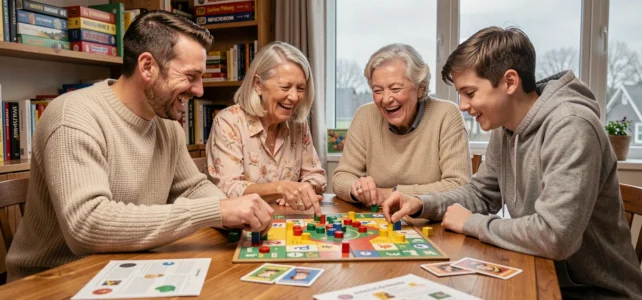
Finding an activity that suits a four-year-old, an eleven-year-old preteen, and two tired adults often presents a logistical puzzle. The issue is not the lack of game and activity ideas for the whole family, but rather sorting them: what format, what location, what budget, what level of preparation? This article compares the main sources of inspiration available and measures what they actually offer according to the family profile.
Comparison of Family Activity Idea Sources by Practical Criteria
Before diving into a list, it is useful to know what each type of source offers and what it requires in return. The table below summarizes the differences between five channels commonly used by families.
| Source of Ideas | Number of Accessible Activities | Age Filtering | Access Cost | Average Preparation Time |
|---|---|---|---|---|
| Booking Platforms (Funbooker, Wondday) | Very high | Yes, often by age group | Paid (service) | Low (online booking) |
| Parent Blogs and Magazines | Variable (lists of 10 to 50 ideas) | Rarely specific | Free | Medium to high (DIY, shopping) |
| Local Outing Apps | High, geolocalized | Sometimes | Free or freemium | Low |
| Social Media (Facebook groups, Pinterest) | Unlimited but unfiltered | No | Free | Variable |
| Specialized Game Sites (educatout, hucky.org) | Structured thematic banks | Yes, by age group or skill | Free or subscription | Low to medium |
The most noticeable difference concerns age filtering. Booking platforms and specialized game sites offer sorting by age group, which significantly reduces search time. Blogs and social media, on the other hand, leave the parent to sort through the information alone.
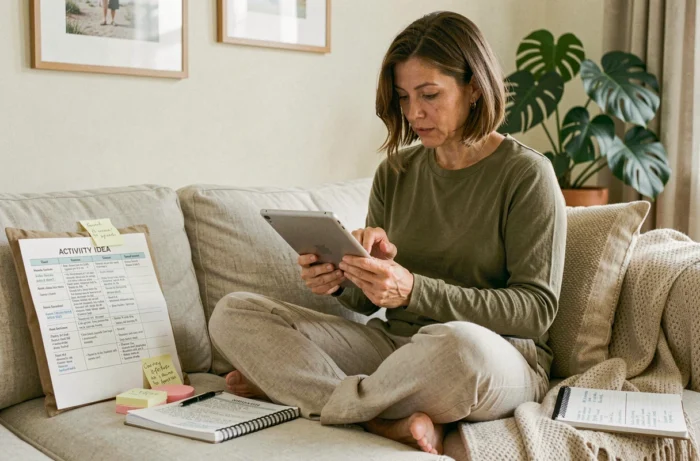
Screen-Free Games for Children: Why Regulatory Frameworks Change the Game
Since July 2, 2025, the law prohibits screen exposure for children under three years old in all childcare settings (nurseries, micro-nurseries, childminders). This measure does not directly concern the home, but it has an indirect effect on the availability of family activities.
Publishers of educational content and gaming platforms are adapting their catalogs to offer more screen-free activities for toddlers. Parents searching for ideas online now find more suggestions for sensory games, motor skills activities, or object manipulation for the 0-3 age group.
For older children, data from the Elfe cohort (published in April 2023) and the Enabee 2022 survey show that daily screen time exceeds public health benchmarks as early as two years old. The average is around one hour per day at two years, with a continuous increase until five and a half years. Among 6-11 year-olds, an increasing share regularly exceeds two hours of digital leisure time per day.
This data highlights a concrete need: families looking to rebalance leisure time need ready-to-use alternatives, not generic lists.
Family Activities by Age: The Gaps Between What Really Works
Most family activity lists treat “the family” as a homogeneous block. In practice, the gap in capability between a three-year-old and a ten-year-old makes the majority of suggestions impractical as they are.
Activities for 0-3 Year-Olds Without Expensive Materials
- Water games in a basin or sensory bin with recycled objects (caps, cups, sponges). Preparation time: a few minutes with materials already available at home.
- Finger painting or stamping on kraft paper, outdoors if possible to limit cleanup. Works from 18 months with close supervision.
- Improvised motor skills course with cushions, cardboard tunnels, and blankets. Adaptable indoors or outdoors, no purchases needed.
Mixed Activities for Siblings with Age Gaps
The real challenge is finding games where each age group has an appropriate role. Treasure hunts work well as long as the clues are differentiated: reading puzzles for older kids, visual or auditory clues for younger ones.
Team building games (forts, marble tracks, cardboard models) allow older children to design while younger ones participate in assembly. The activity works when each child has a task suited to their abilities, not when everyone is doing the same thing.
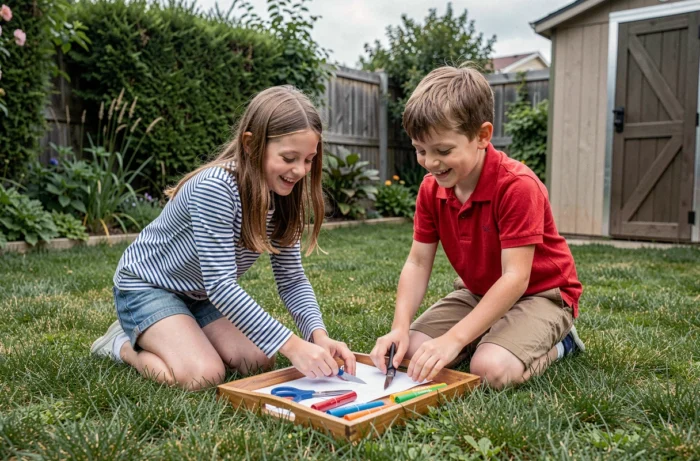
Organizing a Rotation of Family Activities: Time Block Method
Rather than searching for a single activity for an entire afternoon, breaking the time into short blocks yields better results with children of different ages. A block of 20 to 30 minutes per activity limits boredom and allows for alternating types of activities.
- Physical block: ball games, relay races, free dance. Quick energy expenditure, suitable for all ages with simplified rules for younger ones.
- Calm block: coloring, playdough, shared reading. Recovery after exertion, a moment conducive to concentration.
- Collective block: adapted board games (cooperative type), team quizzes, simple cooking. Encourages interaction between generations.
- Free block: each child chooses their activity while adults take a break. This unstructured time fosters independence.
Alternating a physical block and a calm block prevents overexcitement and reduces conflicts among children. This rotation works well both indoors and in nature, with little or no specific equipment.
The choice of an idea source depends less on the quantity of available suggestions than on their relevance to the actual age of the children and the materials available. Families that filter by age group and break their time into short blocks find a suitable activity more quickly than by sifting through a list of fifty unfiltered proposals.