
A thermal mower that empties its tank faster than usual indicates a combustion or mechanical problem. The engine burns excess fuel because the air-fuel mixture is unbalanced, because rolling resistance has increased, or because the fuel itself has lost its properties. Understanding these mechanisms allows for action on the right part at the right time.
Air-fuel mixture and the role of the carburetor in consumption
The engine of a thermal mower operates thanks to a precise ratio between the air drawn in and the gasoline injected. When this ratio leans towards fuel, it is referred to as a rich mixture. The engine then floods its cylinders, wastes gasoline, and often produces black smoke at the exhaust.
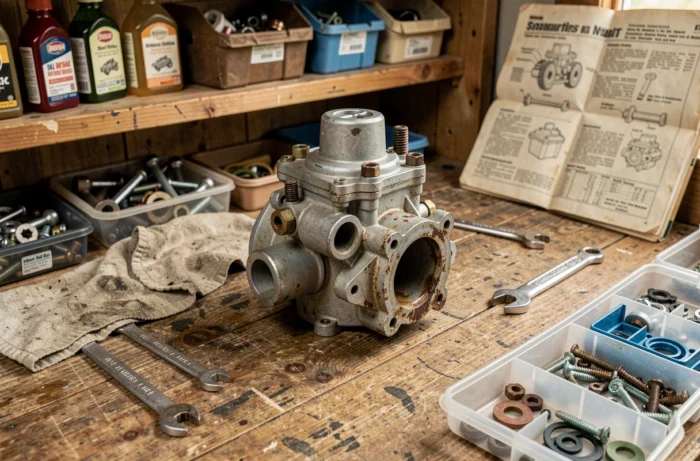
The carburetor is the part that regulates this mixture. On most consumer mowers, it is a diaphragm or float carburetor, without electronic management. Its adjustment depends entirely on the mechanical condition of its internal components.
When a deposit of gum or varnish partially clogs the jets, the carburetor compensates by allowing more fuel to pass through. The result is regular overconsumption, accompanied by unstable idling. To better understand the causes of high thermal mower consumption, it should be noted that this phenomenon is often accompanied by difficult starting or engine stalling under load.
The diaphragm gasket of the carburetor also deserves checking. Over time, it hardens and loses its elasticity, which distorts the flow regulation. Replacing this gasket is inexpensive and restores correct dosing.
Fuel quality and degradation in the tank
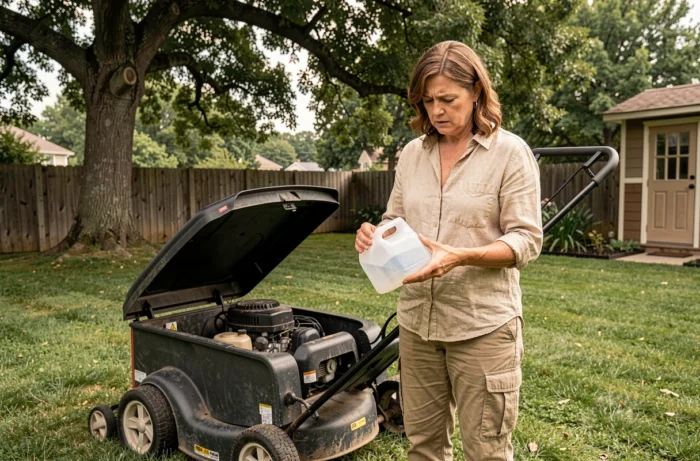
Gasoline is not a stable liquid over time. Several engine manufacturers (Briggs & Stratton, Honda, STIHL) remind us that stored fuel can start to degrade in less than 30 days. The lighter fractions evaporate, and the remaining components form deposits of gum and varnish that clog the fuel circuit.
This phenomenon particularly affects mowers taken out of the garage in spring with leftover gasoline from the previous autumn. Degraded fuel burns poorly and increases consumption, while leaving residues in the carburetor and on the spark plug.
The trap of ethanol in common fuels
The fuels distributed at gas stations contain a variable proportion of ethanol. Ethanol is hygroscopic: it absorbs moisture from the surrounding air. This water then ends up in the fuel circuit, causing corrosion and poor combustion.
E15, a blend containing a higher proportion of ethanol than SP95-E10, is prohibited for small outdoor engines. The EPA expanded the authorization for the sale of E15 year-round in several U.S. states in 2025, increasing the risk of confusion at the pump. In France, SP95-E10 remains the common standard, but checking the ethanol index of the fuel used remains a useful precaution.
To limit degradation, there are two concrete options:
- Drain the tank before wintering and run the engine until it stalls, to purge the fuel circuit
- Use a fuel stabilizer as soon as gasoline is purchased if the mower is not used every week
- Prefer small volumes of gasoline purchased as needed throughout the mowing season, rather than a can stored for several months
Clogged air filter and loss of engine efficiency
The air filter protects the engine from dust, grass blades, and debris sucked in during mowing. When it becomes clogged, the volume of incoming air decreases. The carburetor, calibrated for a given air flow, then injects proportionally too much fuel.
A clogged air filter causes a rich mixture just like an improperly adjusted carburetor, but the cause is upstream. The solution is simpler: cleaning or replacing the filter is enough to restore the correct air-fuel ratio.
On models equipped with a foam filter, washing with soapy water followed by complete drying and a light oil impregnation extends the life of the part. Pleated paper filters cannot be cleaned: they must be replaced.
Mechanical resistance: blades and cutting deck
Overconsumption does not always come from the fuel circuit. The engine can also consume more because it is mechanically forced. Two sources of resistance are common on a thermal mower.
Dull or unbalanced blades
A dull blade tears the grass instead of cutting it. The engine must provide higher torque to maintain the rotational speed, which directly results in increased gasoline consumption. Unusual vibrations often accompany this problem and signal an imbalance of the blade.
Regular sharpening, two to three times per season depending on mowing frequency, maintains a clean cut and reduces engine effort.
Grass accumulation under the deck
After each pass, residues of wet grass stick under the cutting deck. This crust reduces the volume available for air circulation, slows down the blade rotation, and increases engine load. Cleaning the underside of the deck after each use is the simplest and most neglected maintenance measure.
- Turn off the engine and wait for the blade to come to a complete stop before tilting the machine
- Scrape the residues with a plastic or wooden spatula to avoid scratching the deck
- Spray a non-stick product on the internal surface of the deck to limit accumulation during the next mowing
Spark plug and combustion quality
The spark plug ignites the compressed air-fuel mixture in the cylinder. When its electrodes are dirty or worn, the spark loses intensity. Combustion becomes incomplete: part of the fuel passes through the cycle without burning, which increases consumption without producing useful power.
A sooty or oily deposit-covered spark plug is a reliable indicator. Replacing the spark plug restores complete combustion and improves both starting and engine efficiency. The cost of the part is minimal compared to the fuel savings achieved over a season.
The gap of the electrodes also matters. A gap that is too wide or too tight alters the timing and quality of the spark. The correct value is found in the mower or engine manufacturer’s manual.
The gasoline consumption of a thermal mower rarely depends on a single factor. A clogged filter combined with aged gasoline and a dull blade can double the engine effort without the owner perceiving a single clear symptom. Checking these points at the beginning of each mowing season remains the most direct way to maintain normal consumption.