
Driftwood collected at the wrong time or poorly prepared often ends up rotting, cracking, or attracting wood-boring insects once installed indoors. The difference between a durable decorative piece and a piece of wood that deteriorates in a few months lies in two parameters: the collection window and the treatment method applied afterwards.
This article compares the collection conditions based on the wood’s origin (sea, river, lake) and details the treatment steps that determine its longevity.
Salt, tannins, and pests: how the wood’s origin affects treatment
Marine driftwood does not have the same constraints as wood recovered from freshwater. The salt impregnated in the fibers, the residual presence of tannins, and the pest risk vary depending on the environment of origin. This table summarizes the concrete differences.
| Criterion | Marine driftwood | Freshwater driftwood (river, lake) |
|---|---|---|
| Raw appearance | Light gray, polished by sand and salt | Darker, bark sometimes still present |
| Salt content | High (crystallization possible when drying) | None or negligible |
| Mold risk | Low if well dried (salt partially inhibits fungi) | Higher, especially on thick pieces |
| Wood-boring insect risk | Low (prolonged stay in saltwater eliminates them) | Significant (larvae possible in the wood) |
| Desalting soak | Necessary (several days in clear water) | Not necessary |
| Total treatment duration | Longer (desalting + drying) | Shorter (drying + surface treatment) |
Marine wood offers a naturally polished appearance and a sought-after gray hue in decoration. However, it requires a prolonged soaking in freshwater to extract the salt, otherwise, it rises to the surface and produces unsightly whitish deposits.
Freshwater wood requires more careful inspection. Branches collected from the banks of a lake or river may still harbor larvae. A fungicidal and insecticidal treatment of the surface becomes relevant before any indoor use.
Knowing when to collect and treat driftwood directly depends on these characteristics: the collection schedule and the preparation method are not the same whether you are on an Atlantic beach or by a water reservoir.

Driftwood collection period: after storms and floods
Driftwood is not available all the time. Its deposition on the shores directly depends on weather conditions. River floods and coastal storms are the two main transport vectors.
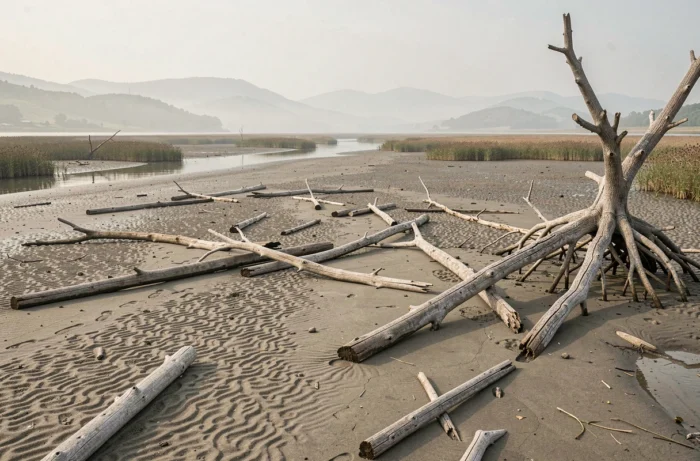
The days following a flood or strong swell event are the most productive collection window. Currents then carry branches, logs, and sometimes pieces of wood of various origins (dead trees, construction elements) that wash up on beaches and banks.
Most productive collection points
- Beaches near river mouths concentrate the largest deposits, as the river current pushes the wood towards the coast.
- The banks of water reservoirs (artificial lakes, dams) accumulate freshwater driftwood after each heavy rain event, often in significant quantities.
- Seaweed lines, identifiable by the line of organic debris along the shore, indicate the exact spot where the wood was deposited during the last high tide or storm.
A point of caution: some municipalities organize driftwood collections after bad weather to clean the beaches. The Climate and Resilience Law has extended the powers of control over waste-related offenses to more public agents. Large-scale collection or collection for commercial purposes may be reclassified as material extraction, especially in protected areas. Favoring beaches outside protected zones and occasional collections remains the safest practice.
Step-by-step driftwood treatment: desalting, drying, and protection
Once collected, raw driftwood is not ready for use. The treatment sequence conditions both future maintenance and the durability of the piece.
Cleaning and desalting
Removing visible debris (algae, shells, embedded sand) with a stiff brush is the first step. For marine wood, a soak in clear water for several days allows for salt extraction. Changing the water regularly speeds up the process. Freshwater wood can go directly to drying after brushing.
Natural drying in the sun
Sun drying remains the most common method. The wood must be exposed to the open air, ideally turned regularly so that moisture evaporates evenly. Insufficient drying leads to mold and cracks when moving indoors, where the air is drier.
The duration depends on the thickness of the piece and the season. Summer months offer ideal conditions: heat and low ambient humidity shorten the necessary time.
Surface treatment and finishing
Once the wood is perfectly dry, two finishing options stand out depending on the intended use.
- For a natural and raw appearance, applying a clear varnish or linseed oil protects the surface without altering the characteristic gray hue of marine driftwood.
- For pieces intended for outdoor use (garden, terrace), a fungicidal product suitable for wood limits the development of mold related to ambient humidity.
- For thick branches or pieces recovered from freshwater, a preventive insecticidal treatment targets any wood-boring larvae still present in the fibers.
The application is done with a brush over the entire surface, focusing on porous areas and cut ends. A second coat after the first has completely dried reinforces the protection.
Driftwood in interior decoration: maintenance and durability
Properly treated driftwood requires little maintenance. Regular dusting and an annual check of the surface condition are sufficient for pieces placed indoors. Warning signs to watch for: appearance of fine powder (sign of insect activity), dark spots on the surface (mold), or widening cracks (humidity problem).
Well-dried and surface-treated driftwood retains its appearance for years. Marine pieces, naturally devoid of sap and bark after their long stay in water, exhibit superior dimensional stability compared to freshwater wood. This factor explains their popularity for mirrors, lamps, and decorative frames.
The timing of collection, adherence to drying time, and application of a protective product suitable for the wood’s origin are the three variables that separate a stable decorative piece from a piece of wood that deteriorates in a few months.