
Etam jewelry occupies a special place in the landscape of accessible fashion in France. The brand, historically associated with lingerie and swimwear, has expanded its offering to accessories that blur the line between costume jewelry and a fully-fledged styling piece. This season, several factors converge to explain their rise in visibility: the trend towards accumulation, affordable prices, and regulatory constraints that push brands to pay attention to the composition of their pieces.
REACH Regulation and Costume Jewelry: What It Means for Etam
The costume jewelry sold in France is not just decorative gadgets from a regulatory standpoint. The REACH regulation strictly governs nickel release and sets thresholds for lead and cadmium in pieces that are in prolonged contact with the skin. For a brand like Etam, present in hundreds of retail outlets in France, compliance with these standards conditions the placement of products on shelves.
This framework pushes brands to work with more stable alloys and to favor materials like stainless steel, which offers better durability while respecting regulatory limits. The concrete result for the buyer: pieces that last longer over time, even when worn daily, and a reduced allergic risk compared to non-compliant entry-level costume jewelry.
When choosing from the Etam jewelry to discover, this compliance with European standards is part of the equation, even if it is rarely highlighted by the brand itself in its communication.

Layering Jewelry: The Accumulation Trend That Benefits Etam
The current season confirms a movement that has been underway for several years: jewelry is worn in accumulation rather than as a single piece. A mix of textures, chain lengths, and stacked thin bracelets on the wrist. This styling logic transforms jewelry into a composition tool, just like a scarf or a belt.
Etam takes advantage of this phenomenon with collections designed to be combined. The pieces are conceived as modules: a single bracelet remains discreet, but worn with three or four, it creates a different visual effect. This modular approach has an obvious commercial advantage: it encourages the purchase of several complementary pieces rather than a single isolated jewel.
What Price Makes Possible
The accumulation works even better when the unit price remains low. In the accessible costume jewelry segment, the entry cost allows for experimentation without financial risk. Wearing five mismatched bracelets becomes a style gesture rather than an investment.
On the other hand, the downside of this pricing position remains the actual durability of the pieces. Field returns vary on the durability of finishes after several weeks of daily wear, especially during the summer when sweat and sun exposure accelerate wear and tear.
Costume Jewelry and Summer: The Question of Water Resistance
One of the least addressed angles in mainstream fashion content concerns the actual wearability of costume jewelry at the beach or pool. Salt and chlorine weaken most pieces, even those marketed as resistant.
- Stainless steel, often used in accessible collections, withstands water better than plated brass but can still tarnish with repeated exposure to chlorine or saltwater.
- Rinsing and drying jewelry quickly after each swim extends their lifespan, a simple gesture that most wearers neglect.
- Pieces with glued elements (beads, cabochons, rhinestones) are the most vulnerable: water seeps under the setting and gradually detaches the decorative elements.
A piece of costume jewelry worn daily at the beach without maintenance will not last the season. This observation applies to Etam as well as to most brands positioned in this price segment. The promise of style remains intact, but it comes with a limited lifespan if usage conditions are ignored.
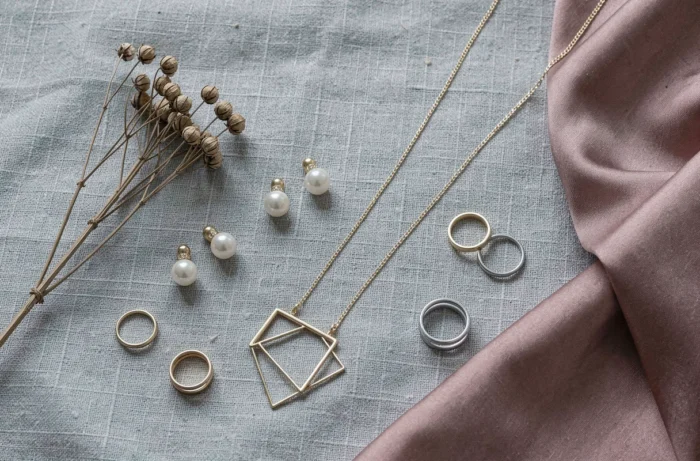
Etam Fashion Accessory: Between Brand Strategy and Consumer Expectations
Etam does not sell jewelry like a jeweler or even a specialized costume jewelry store would. The brand integrates its accessories into a global universe that mixes lingerie, swimwear, and ready-to-wear. Jewelry acts as a complementary purchase, often presented near the checkout or in association with a complete outfit online.
This strategy of integrated accessory jewelry within a complete look alters the perception of the product. One does not buy an Etam necklace for its intrinsic value, but because it complements a swimsuit, a summer ensemble, or an evening look. Jewelry becomes a coordinating element rather than a standalone piece.
The Limits of the Approach
The integration of jewelry into a textile ecosystem has its limits. Consumers looking for durable jewelry or a more defined style turn to dedicated brands. The available data does not allow for precise measurement of loyalty in the jewelry segment at Etam, but the impulsive buying logic associated with this type of product suggests frequent basket renewal rather than attachment to specific pieces.
The positioning remains consistent with the brand’s overall promise: to offer accessible style, renewed each season, without claiming the longevity of a designer piece. For a buyer looking to follow trends without a heavy financial commitment, the proposition holds up. For someone expecting a signature piece to wear for years, this segment is not the right fit.
The upgrade in materials used in costume jewelry, driven by regulation and demand for durability, could change this equation in the upcoming seasons. For now, Etam jewelry remains a strictly seasonal product: designed to be worn intensively for a few months, then replaced.