
The correct form is call me, without -s. This spelling corresponds to the verb call conjugated in the 2nd person singular of the present imperative. The mistake “calls me” is among the most common errors in written French, including in professional contexts such as emails or texts.
The mechanism of the imperative that removes the -s
The present imperative is a mood without an expressed subject. In the present indicative, we write “you call” with a final -s. When switching to the imperative, this -s disappears for 1st group verbs.
The confusion arises from a logical reflex: since the imperative in the 2nd person addresses “you,” one reproduces the indicative ending. This logic is incorrect for -er verbs.
- Present indicative: you call, you eat, you speak (with -s)
- Present imperative: call, eat, speak (without -s)
- Exception: the -s reappears before “en” and “y” for phonetic reasons, as in “eat some” or “go there”
To remember the rule for writing call me, simply check the verb group. Call belongs to the 1st group: no -s in the imperative.
Doubling the “l” in the verb call: when and why
The infinitive is written “call” with a single “l”. The conjugation doubles this “l” whenever the following syllable is silent. This doubling indicates a change in pronunciation: the “e” before the doubled consonant is pronounced like an open “è”.
Compare the conjugated forms:
- I call, you call, he calls, they call – two “l” because the ending is silent
- We call, you call – a single “l” because the ending is pronounced
- I was calling, we were calling – a single “l” in the imperfect, the ending being voiced
The doubling of the “l” depends solely on the pronunciation of the final syllable. This principle also applies in the simple future (I will call, with two “l”) and the present subjunctive (that I call, with two “l”).
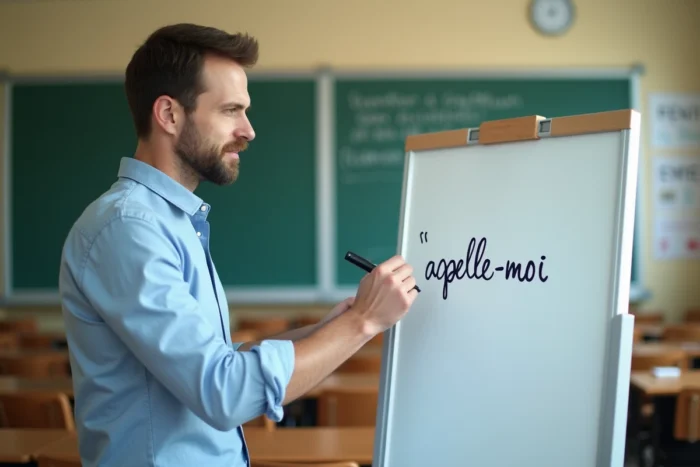
In the imperative, “call” indeed has two “l” since the ending -e is silent. The doubling rule and the absence of -s rule combine in “call me”.
The hyphen with personal pronouns in the imperative
The imperative requires a hyphen between the verb and the following object pronoun. We write “call me,” “tell him,” “look at them.” Without a hyphen, the spelling is incorrect.
This hyphen is not decorative. It indicates that the pronoun is attached to the verb in a construction where the subject has disappeared. In the negative form, the pronoun goes back before the verb and the hyphen disappears: “do not call me.”
A common trap is to forget this hyphen in quick messages. “Call me” without a hyphen constitutes a spelling mistake, even if it often goes unnoticed in speech.
Special case with “en” and “y”
When the pronoun “en” or “y” follows an imperative of a 1st group verb, the -s reappears to facilitate oral liaison. We write “think of it” and not “think of it,” “talk about it” and not “talk about it.” This exception does not apply to “call me” since “me” is neither “en” nor “y”.
Call conjugated in other tenses: the forms that cause problems
The difficulty of the verb call is not limited to the imperative. Several tenses generate hesitations about the number of “l”.
In the simple future, the doubling is systematic: I will call, you will call, we will call. The final syllable of the root is silent for all persons, so the “l” doubles everywhere.
In the present subjunctive, the pattern follows that of the present indicative: that I call, that you call, that he calls, that they call (two “l”), but that we call, that you call (a single “l”).
In the imperfect indicative, a single “l” is sufficient for all persons: I was calling, you were calling, we were calling. The voiced ending prevents doubling.
The present conditional, built on the future root, logically retains the two “l”: I would call, you would call, he would call.
The noun “call” and the confusion with the verb
The noun “call” is written with a single “l” and without a final -e. Do not confuse the noun “a call” and the conjugated form “he calls”. The sentence “make a call” uses the noun, while “call him” uses the verb in the imperative.

Common mistakes with call me in everyday writing
Language correction platforms report that the error “calls me” regularly appears in professional emails and instant messages. Three errors often accumulate in the same sentence:
- Adding an -s by analogy with the indicative (“calls me”)
- Forgetting the hyphen (“call me”)
- Hesitation about the number of “l” (“call me” or “call me”)
French school programs, especially in cycles 3 and 4, explicitly target the conjugation of the present imperative in exercises and assessments. Instructions like “write to me,” “reply to me,” “call me” serve as recurring training supports.
The correct spelling can be summarized in three quick checks: 1st group verb so no -s, final syllable silent so two “l,” pronoun after the verb so hyphen. These three points combined yield call me, the only accepted form in French.